Tahnia Roberts: Ngaben

Photo © Tahnia Roberts-All Rights Reserved

Ngaben is the cremation ritual/ceremony performed in Bali to send the deceased to the next life. The bodies of the deceased are placed in elaborate sarcophagi, and cremated following rituals and ceremonies that are full of simultaneous solemn and joyous pomp. The Balinese believe that the deceased will either reincarnate or find final rest known as moksha, and that the bodies are temporary shells, considered impure.

Tahnia Roberts' Ngaben is a collection of photographs she made during the cremation of the late A.A. Mangkling, an elderly Balinese. A word of caution is necessary since there are images of the deceased in full view. I ought to add that Ms Roberts had the permission of the family to photograph the cremation ceremony. Her description of cremation ceremonies is quite comprehensive and informative.

Tahnia Roberts is a portrait and documentary photographer, originally from New Zealand, who is currently resident in SE Asia traveling extensively to experience authentic cultural activities of the region.

I suppose I ought to mention my own Ngaben gallery, which was more rural and perhaps less elaborate than the one documented by Ms Roberts.

Fuji X Pro-1: Shooting From The Hip/Vivid vs B&W

Photo © Tewfic El-Sawy-All Rights Reserved
With this month's credit card statement settled, I can now claim complete ownership of my Fujifilm X Pro-1 and the Fujinon 18mm lens that I bought last month, so feel I've earned the right to update my impressions having used it in the streets of New York as frequently as I could.

Let me start by saying that looks can be deceiving. Operating the Fujifilm X Pro-1's various options can be quite complex, and took longer than I expected, especially as I have the unfortunate habit of not reading manuals, preferring to learn on the fly.

Much has been written (and continues to be written) on the X Pro-1's performance, strong and weak points, quirks (some infuriating and others not so much) and superlative image quality...so I won't repeat them here, apart from saying this:

1. As I do much of my street photography in the streets of NYC by shooting from the hip, I rely on the X Pro-1's auto focus. Its auto focus is not infallible, but even my Canon 5D Mark II and 7D are not, so that's an issue I can easily live with. The main gripe I have with the X Pro-1 is that it occasionally goes to sleep, and it takes a few jabs at its shutter to wake it up. By that time of course, the subject of my attention has walked on by, or the moment I wanted to capture passed.

And to me, that's the main negative of the X Pro-1 insofar as shooting from the hip is concerned.

2. I tried a couple of color film settings, and I'm occasionally disappointed in the rendition of the Velvia (or vivid) setting. The color photograph above was made using the Vivid film simulation setting, and I just don't like it. While the whole scene is more or less fine, the color of the man's jeans (as an example) is unnatural, and seems too over-saturated.

3. The battery life of the X Pro-1 sucks. As I mentioned in previous posts, I manage to get about 300 images on one charge (that includes a bit of chimping). On the other hand, it recharges quite rapidly. So on my shopping list, is another battery. For an all day kind of shooting, 2 batteries (and perhaps 3) are the minimum.

That all said, I am quite satisfied with the performance of the X Pro-1 and I anticipate getting more comfortable with it during the next few weeks, and also expect that Fuji will come up with further firmware updates.

I added a monochrome version (processed via LR) which I much prefer to the color one. I suspect that if I claimed that it came from the new Leica MM, no one would guess otherwise.

Finally, for a website that aggregates all there is to know about the Fuji X Pro-1, drop by Thomas Menk's Scoop.it | Fuji X Pro 1 blog.

Photoburst Goes Big (And Large)


I have blogged about Photoburst, a travel photography daily contest, before...however its website was just revamped in a dramatic fashion, with its daily winning photograph large enough to take up all of my large monitor...and readers of this blog know my often expressed preference for large images.

It's a real eye-candy now!

The basis for the contest is a simple one. The best photograph submitted by its contributors is uploaded, and showcased for that day. The author of the best photo of the month receives a US$50 gift certificate to Kiva.

Gastão Bettencourt, Pedro de Sousa and Pedro Patrício are the three photographers behind Photoburst, and since inception, it attracted hundreds and hundreds of travel photographers and their submissions. I've seen impressive quality amongst the submissions, from well-established photographers with professionally-built websites, and from emerging photographers with Flickr galleries. The submissions range from landscapes to environmental portraiture, from candids to posed photographs.

Photoburst also affirms that all photographs contained on its website remain the property of their authors, as indicated over each photograph.

So whether you seek to participate in Photoburst's contest by submitting one of your travel photographs or just get your daily travel photography fix, bookmark its website and make it a daily destination. You're certain to get your travel photography buzz!

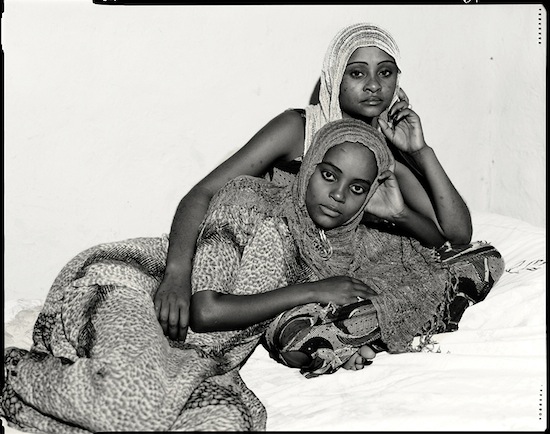
Christian Witkin: Ethiopia

Photo © Christian Witkin-All Rights Reserved

"You can read people's faces, you can see how they treat themselves, what kind of lives they live, it's all in the exterior." 

Here's the work of Christian Witkin, a Brooklyn-based photographer known for his advertising and editorial work for major publications, who's now returning to fine art, the foundation of his personal photographic work.

His current projects include a massive 16-year study of India, Women, Ethiopia and a Thai Ladyboy project. I was curious to see how an advertising, celebrity and fine art photographer would depict the beauty of the Ethiopian people, and you can judge for yourself how well he's done it.

I was very interested to read in article on Cool Hunting as to how Christian took a medium format camera to 14th Street (which is one of my favorites spots for street photography) in order to build his portfolio, and that he now uses a 4 x 5 Linhof Technika (a large format camera system) when he travels. He also espouses the style of rarely cropping his photographs.

The Thai Ladyboy portraits are also masterfully photographed and composed.